
Efflorescence and cement film: cleaning brick facades with BONDERITE C-MC 11110
Formerly SCALE GON BUILDING: an acid cleaner free from hydrochloric and phosphoric acid, developed with brick and concrete manufacturers
The bricks were carefully chosen, but once the facade is up, it becomes covered in white stains. This efflorescence is one of the most common problems in masonry. It is most often caused by unfavourable weather conditions during construction.
In June 2018, Saphonyx presented Henkel’s SCALE GON BUILDING LIQUID to remove it. It has now been replaced by BONDERITE C-MC 11110 (formerly SCALE GON BUILDING). This article has been updated with the Henkel data sheet of October 2023 and the Saphonyx data sheet of 2024.

The same facade, before (left) and after treatment (right)
At a glance
10 to 50%
dilution in water depending on the extent of the deposits; the product can also be used undiluted
5 to 10 min
contact time before rinsing with clean water
± 1 L / 1.5 m²
consumption depending on the contamination and the absorbency of the substrate
2 months to 1–2 years
after the joints have been pointed: the window for treatment; after that, sandblasting is needed
Efflorescence or saltpetre?
Saltpetre is a mineral salt composed largely of potassium nitrate. It affects all building materials, especially in old buildings that are highly exposed to moisture.
Efflorescence mainly affects the bricks of new houses. It has two origins, which are not treated in the same way: carbonation and sulphation.
Carbonation or sulphation: two causes, two treatments
Carbonation
- Cause: the facade gets wet while the mortar is drying. A film of water prevents carbon dioxide from penetrating, and the lime in the mortar is not bound.
- Effect: when the wall dries, the free lime comes out and, on contact with the air, turns into calcium carbonate, a hard white film.
- Water test: the deposit does not dissolve and does not disappear on its own.
→ Treat with BONDERITE C-MC 11110 between 2 months and 1 to 2 years after the joints have been pointed.
Sulphation
- Cause: soluble salts (sulphates) present in the brick or mortar. Rain carries them into the pores of the masonry.
- Effect: when the wall dries, they rise back up and crystallise on the surface of the brick.
- Water test: the deposit dissolves, but it keeps coming back as long as the salts in the wall have not finished reacting, sometimes for years.
→ Wait one season, clean the facade, then impregnate it with a water repellent that lets it breathe.
How carbonation occurs
In dry weather
Cement and water react (hydration) and form calcium hydroxide, or lime.
Carbon dioxide from the air penetrates the brick and the joint. It binds the lime in the mortar, which hardens: this is carbonation.
→ The calcium carbonate stays in the joint: the facade stays clean.
In wet weather
A film of water covers the facade and prevents carbon dioxide from getting in. The lime remains free and soluble in the mortar.
When the temperature rises and the wall dries, the water carries the lime to the surface, where it meets the carbon dioxide in the air.
→ Calcium carbonate forms on the surface of the brick: the white stains appear.
Instructions for use
- 1
Carry out a test
Test 10 to 50% solutions on a small area, then prepare the solution at the appropriate concentration.
- 2
Protect
Carefully cover blue limestone, marble, travertine and other calcareous stone, for example with adhesive tape. The product is safe for glass and aluminium, but they must be rinsed thoroughly.
- 3
Dampen if necessary
Dampening beforehand is generally not necessary; it is warranted on very absorbent substrates.
- 4
Apply
By brush or low-pressure sprayer (Nicovairless type, which is faster), from bottom to top, at a temperature above 10 °C.
- 5
Leave the cleaner to work
Leave to act for 5 to 10 minutes. Brushing can help to loosen the white flakes.
- 6
Rinse
Rinse with clean, cold water, from top to bottom. Repeat the operation if necessary.
Any product residues are transparent and harmless to stone (Henkel data sheet, October 2023).
What to avoid
- A high-pressure cleaner on its own: the water sprayed onto the facade only makes the problem worse.
- Detergents based on hydrochloric or phosphoric acid: they almost always have undesirable effects. In the Netherlands, the KNB, the brick manufacturers’ association, also advises against them.
- Waiting too long: after a few years, the calcium carbonate hardens into a crust that can only be removed by sandblasting.
Prevent
Bricklaying and jointing must be carried out in good conditions, which is not easy in the Benelux. The facade must stay dry for 48 hours after repointing. If jointing is done in the rain, efflorescence can be expected to appear after a few weeks.
To limit the influence of the weather, the building is sometimes “wrapped”, which allows bricklaying and repointing to continue in rainy weather. Even so, efflorescence cannot be ruled out, because moisture in the air can pass through the wrapping: the risk can be reduced, but never avoided one hundred per cent.
The product
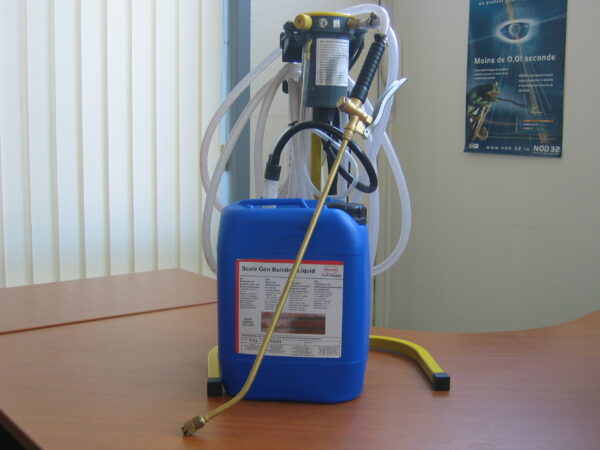
BONDERITE C-MC 11110
Acid cleaner (red liquid), formerly SCALE GON BUILDING. It removes efflorescence and cement film from hardened masonry, as well as colour differences in joints. Its formula contains neither hydrochloric acid nor phosphoric acid: it is suitable for all types of brick, including those containing manganese, and for all mortars. It also removes cement film and plaster marks from non-calcareous tiles.
Ready to use or diluted up to 50%. Brush or low-pressure sprayer; 5 to 10 min; rinse with clean water. ± 1 L per 1.5 m². Not recommended on marble, blue limestone and travertine. 25 kg jerrycan. Store between 5 and 30 °C; 2 years in unopened packaging.
According to the Saphonyx data sheet, the product is approved by brick manufacturers (Desaegher, Desimpel, Desta, Koramique, Nelissen, Vande Moortel, Vandersanden, Wienerberger) and by repointing mortar manufacturers (Cantillana). This list is not exhaustive.
Further information
Mineral facades: cleaning and renovation
All products for brick, stone and concrete facades.
Our solutions for facade cleaning
Cleaning, renovation, graffiti and protection of facades.
See also:
Renovation of mineral facades →
Need advice?
Tell us about your parts, substrates, soils and equipment: we will recommend a product and method and send you the technical data sheets and safety data sheets or a quotation.